
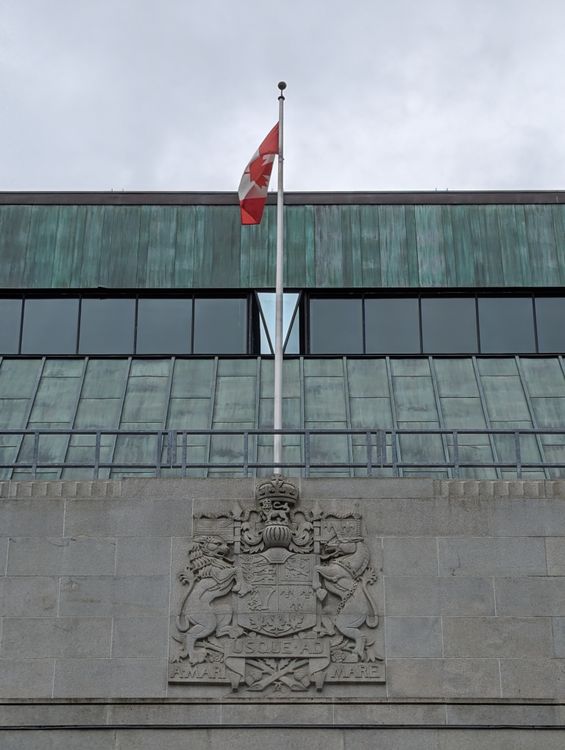
Canada has reimposed sanctions on 11 Iranian entities, accusing them of contributing to Iran’s nuclear activities and its ballistic missile program, in a move announced on Tuesday, November 10, 2026, at a meeting of Group of Seven foreign ministers in Paris.
Foreign Minister Anita Anand announced the measures in the French capital, saying they were intended to restrict Iran’s access to funding and sensitive technology linked to its nuclear and missile programs. The announcement makes Canada the latest Western government to tighten economic pressure on Tehran while fragile talks to end the war continue through intermediaries.
“Canada’s position is unequivocal: Iran must never be allowed to obtain a nuclear weapon,” a foreign ministry statement quoted Anand as saying.
The decision restores sanctions on entities Canada had removed from its lists a decade ago. The United States has been at war with Iran since joint American and Israeli airstrikes on February 28, and although President Donald Trump said this week that a renewed military campaign looked unlikely, the naval blockade of Iran remains in place and diplomacy has yet to produce a deal.

What the sanctions cover
The measures target 11 entities that Ottawa says contributed to “the Iranian regime’s proliferation-sensitive nuclear activities and ballistic missile program or to the financing of its malign activities,” according to the foreign ministry statement.
The list reaches across Iran’s nuclear fuel cycle, its oil trade and its banking system. It includes Iran’s Nuclear Fuel Production and Procurement Company and the Nuclear Reactors Fuel Company, two bodies at the heart of the country’s atomic program, as well as the National Iranian Oil Company and the National Iranian Tanker Company, which handle the crude exports that fund much of the Iranian state.
The remaining names are Kala Naft, the Naftiran Intertrade Company, Bank Mellat, Bank Melli, the Iran Bank of Industry and Mine, the Export Development Bank of Iran and the Iran Insurance Company. Together they cover the financial plumbing through which Iran buys equipment, moves money and insures the shipments that keep its nuclear and missile programs supplied.
The sanctions bar Canadians and Canadian companies from dealing with the listed entities and freeze any assets they hold in Canada, while signalling to banks and businesses elsewhere that doing business with them carries legal and reputational risk.
The United States, its European allies and Israel have long accused Tehran of using its nuclear program to conceal efforts to develop the capability to produce weapons. Iran insists its program is for peaceful purposes only, a claim international inspectors have repeatedly questioned.
Why Canada is acting now
The timing matters. Canada removed these same entities from its sanctions lists in 2016, after the 2015 nuclear deal between Iran and world powers came into force. Under that agreement, Iran accepted limits on its nuclear program in exchange for relief from sanctions.
Ottawa said on Tuesday that the decision to reimpose the measures reflected Tehran’s conduct since then. The foreign ministry said Iran had repeatedly failed to cooperate with the International Atomic Energy Agency, the United Nations nuclear watchdog, over its nuclear activities and had not complied with the provisions of earlier United Nations Security Council resolutions.
That failure to cooperate has become harder to ignore as the war has dragged on. International inspectors have had limited access to Iranian nuclear sites, and questions about undeclared material have gone unanswered for years.
There is also a blunt political logic. Canada has kept up a hard line on Iran even when others were talking: Ottawa severed diplomatic relations with Tehran in 2012, and in 2024 it listed Iran’s Islamic Revolutionary Guard Corps as a terrorist entity. Reimposing sanctions is consistent with that record, and it gives Anand something concrete to bring to the G7 table in Paris.
The move also fits the mood of the G7 meeting itself. Foreign ministers from the world’s richest democracies gathered in Paris on Monday for talks running through Tuesday, with Ukraine and Iran at the top of the agenda. Read our report on the G7 foreign ministers meeting in Paris.

A war paused, not ended
The sanctions arrive while the war itself sits in an uneasy pause. Trump said on Monday that a renewed military campaign against Iran was “quite unlikely” and “doesn’t seem to be necessary,” adding that his administration wanted “a long-term solution.” He told Reuters that Qatar and Saudi Arabia were eager for a peaceful solution to the conflict, but that the United States was ready to resume military strikes if necessary.
Qatar’s prime minister, Sheikh Mohammed bin Abdulrahman Al Thani, described his talks with Trump and Vice President JD Vance about Iran on Monday as “positive.” France’s foreign minister said on Tuesday that the Qatari prime minister would make an unscheduled stop at the G7 meeting in Paris, underlining how central the Gulf mediator has become to the diplomacy.
Behind the public optimism, the military picture remains tense. The United States evacuated aircraft from the Royal Air Force base at Mildenhall in England on Monday after a threat from Iran, according to sources cited by the Wall Street Journal. The naval blockade of Iran continues, and Trump has warned that if strikes resume, the United States has identified targets it could hit quickly.
An Iranian official told Reuters last week that Tehran had submitted a proposal on nuclear issues to the United States through Qatar, but that further discussions would depend on Washington first meeting Iranian demands, including sanctions relief, access to frozen assets and war reparations. Washington has said nuclear issues must feature in the initial talks, a gap that suggests the negotiations are still at an early and fragile stage.
Iran’s own signals have been mixed. The country’s security chief, Mohsen Rezaei, said in October that Tehran was debating whether to lift its longstanding ban on nuclear weapons if hostilities resume, although no such decision had been taken. The remark has alarmed Western governments and hardened the case for measures like the ones Canada announced.
France’s cyberattack accusation adds pressure
Canada’s move is not the only pressure Iran faced in Paris this week. On Monday, France publicly accused a unit of Iran’s Revolutionary Guards of hacking refrigeration systems at around 700 supermarkets last month, spoiling food worth tens of millions of euros and starting fires in stores across the country. Paris called the attack unprecedented in scale and aggression, summoned Iran’s ambassador and promised sanctions at a European level. Read our report on France’s accusation.
The French accusation and the Canadian sanctions, announced a day apart in the same city, point in the same direction: Western governments are using every tool short of war to squeeze Tehran while the shooting has stopped.
Whether that campaign works depends on Tehran’s calculation. Sanctions have rarely changed Iranian policy on their own, and Iran has spent years building workarounds, from shadow tanker fleets to front companies. The entities Canada listed on Tuesday are already under American sanctions, which limits the direct financial damage of Ottawa acting alone. But each new listing narrows the space in which they can operate, and a coordinated Western front makes evasion harder and more expensive.
What the sanctions will and will not do
It is worth being clear about the limits of what Canada announced. The 11 entities are not new discoveries; they are familiar names that have been sanctioned before, by Canada and by others. Their assets in Canada are likely to be small, and Iranian banks have had little direct business with Canadian institutions for years. The practical effect in the short term will be modest.
The value of the move is political and cumulative. It tells Tehran that the patience of even the more distant Western powers is wearing thin, and it tells Washington and Europe that Canada is prepared to act. It also creates a marker that can be traded away: sanctions imposed for a nuclear program can be lifted as part of a deal, and the Canadian measures could become bargaining chips if negotiations ever get serious.
For ordinary Iranians, the sanctions are another reminder that their country’s confrontation with the West is far from over, even as the bombs have stopped falling for now.
What happens next
Three things will show whether Tuesday’s announcement matters. First, the G7 meeting in Paris concludes on Tuesday, and its final statement will reveal whether the other members are prepared to match Canada’s move or go further. France is already pushing for European sanctions over the supermarket cyberattacks; Britain, Germany and Japan will have to decide how far they are willing to go.
Second, the diplomacy through Qatar will either produce a meeting or stall. The Iranian proposal is on the table, the American conditions are known, and the gap between them is the space in which the war either ends or restarts. The Qatari prime minister’s unscheduled stop in Paris suggests the mediators are working hard to close it.
Third, the inspectors will keep asking for access, and Tehran will keep deciding how much to give. The International Atomic Energy Agency’s ability to verify what Iran is doing remains the single most important question in the standoff, and it is the question Canada cited when it reimposed the sanctions.
Canada’s message on Tuesday was simple, and Anand put it in a single sentence: Iran must never be allowed to obtain a nuclear weapon. Whether the sanctions are enough, and whether diplomacy can finish the job that pressure alone has not, will be decided in the weeks ahead in Paris, in Doha and in Tehran.