
LONDON — The foreign ministers of the United Kingdom, Canada, Australia and Italy issued a rare joint demand on Sunday, telling Israel to open Gaza’s crossings at once and let in the shelter supplies they say are piling up at the border while families sleep in flooded tents. The four governments called the humanitarian situation in Gaza “dire” and warned that the first winter storm had already brought “further suffering” — with worse weather still to come.
The statement, published by Britain’s Foreign Office on Sunday evening and issued in identical form by Global Affairs Canada, is the sharpest collective rebuke of Israel’s handling of aid into Gaza since the ceasefire brokered by the United States took effect in October. “People in Gaza desperately need shelter and humanitarian assistance,” the ministers wrote. “Yet 150,000 tents and other vital supplies are being held at the border and prevented from entering Gaza.” Their message to Israel was blunt: “Stop the delays now and allow immediate, rapid and unimpeded humanitarian access throughout Gaza. The crossings must be opened, and the tents allowed in.”
What the four ministers actually said
The joint statement is short — only a few paragraphs — but every line carries weight, because it was signed by the foreign ministers of four governments that have usually preferred to raise their concerns about Gaza in private. Australia’s Foreign Minister Penny Wong joined her counterparts from Canada, Italy and the United Kingdom in putting their names to the text.
The ministers tied their demand directly to the weather. “The recent floods have brought further suffering — and this was only the first storm of the winter,” they wrote. Their central claim is a number: 150,000 tents, plus other vital supplies, sitting outside Gaza while the people who need them sleep in tents that are already leaking, collapsing or washing away. “This situation is entirely reversible — and there is still time to act before the winter fully sets in,” the statement says.
The statement goes further than shelter. It demands that “dual-use items necessary for humanitarian operations and early recovery must be granted entry before it is too late” — pipes, pumps, generators and building materials that aid agencies say are essential to repair water networks and keep hospitals running. The demand for Gaza humanitarian access is the heart of the statement. It also calls on all sides to implement the Comprehensive Plan for Gaza, respect the ceasefire and honour their obligations under international humanitarian law.
The floods that turned a warning into an emergency
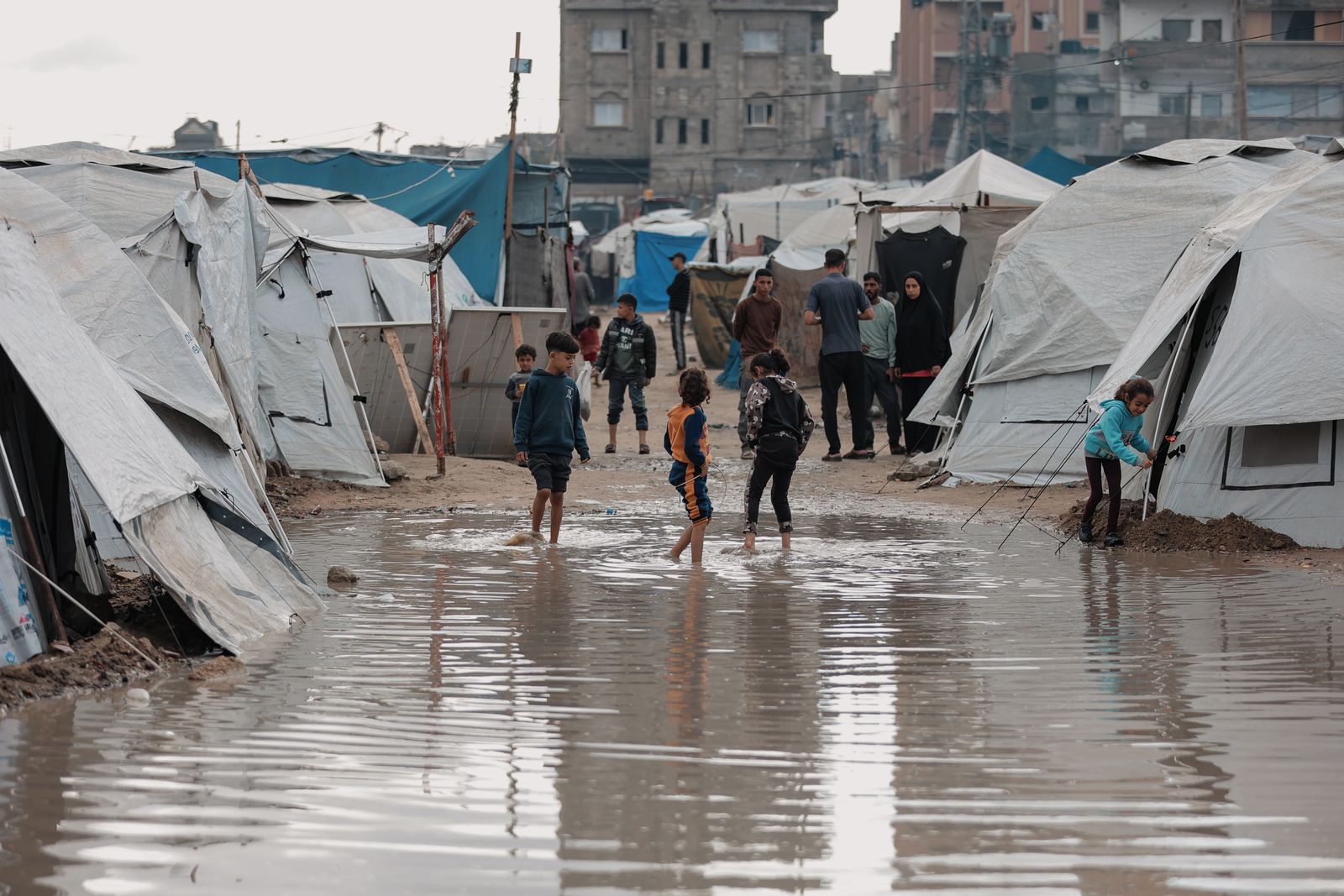
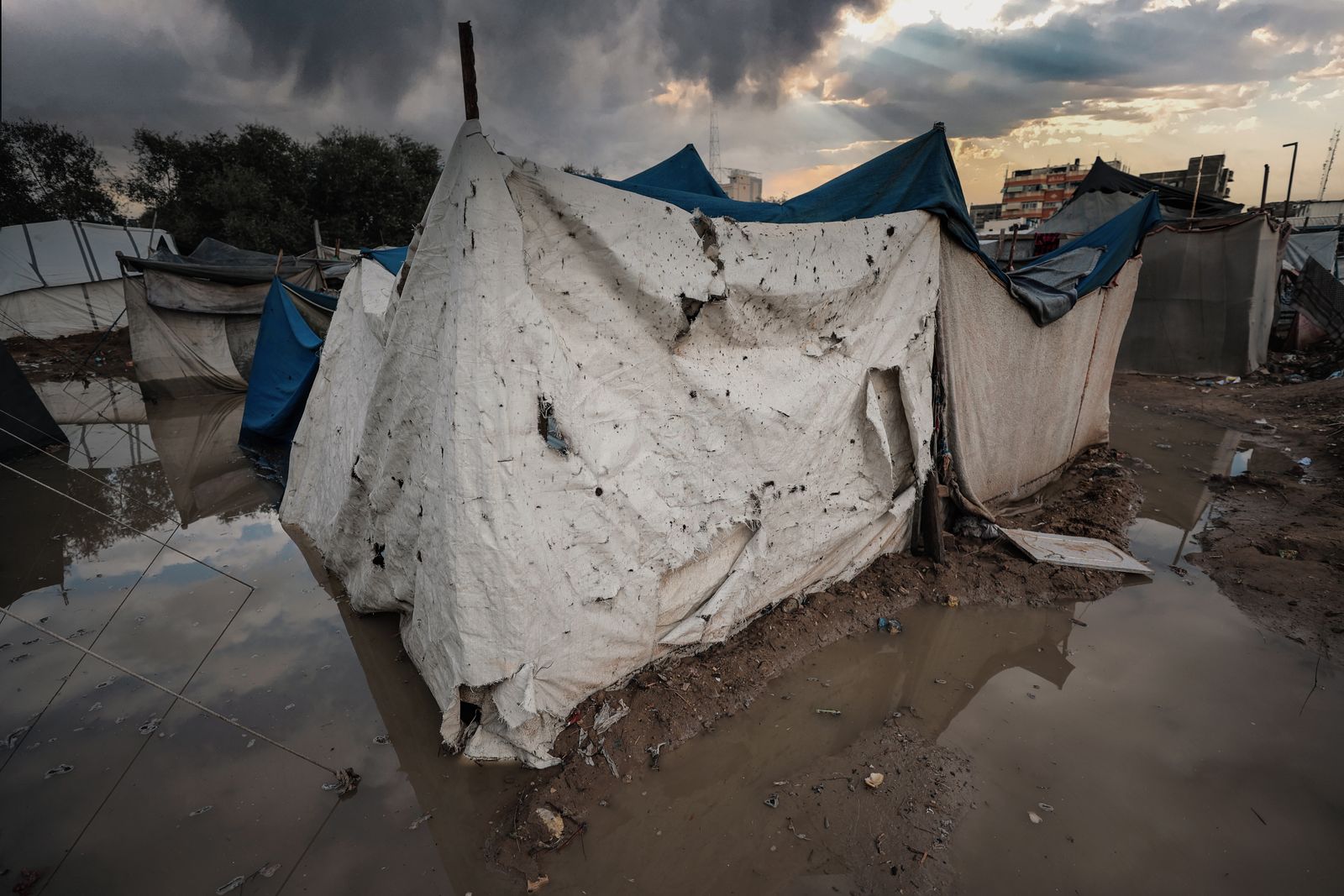
The ministers were responding to a storm that aid workers say exposed just how fragile life in Gaza has become. Heavy rain began falling on November 6, and within days the United Nations’ humanitarian office reported that flooding and a landslide had killed people, damaged thousands of shelters and forced the suspension of critical services. The UN reported five people killed, and said waters rose as high as 1.5 metres in some places.
UN site managers reported that the weekend storm of November 6 to 8 alone affected more than 26,000 households, destroying about 6,100 shelters and damaging a further 17,400. By November 9, UN alerts suggested the rain may have hit more than 46,000 households.
The human cost fell hardest on the most vulnerable. UNICEF reported that three children aged between four and eight were killed alongside their mother when a sand dune collapsed onto their tent in Deir al-Balah, in central Gaza, after heavy rainfall. Gaza’s health authorities confirmed that a nine-month-old baby died of hypothermia in Khan Younis. These were deaths caused by cold, water and collapsing shelters — not by bombing.
About 65 percent of Gaza’s population — roughly 1.4 million people — now live in tents or makeshift shelters, according to the UN’s aid coordination office. The Global Shelter Cluster estimates that Gaza’s residents need at least 1.7 million mattresses and 121,000 tents to get through the cold and rainy season.
The 150,000 tents waiting 50 kilometres away
The most striking detail in the ministers’ statement is not the demand itself but the distance involved. More than 150,000 tents bought by humanitarian partners and member states are sitting in warehouses outside Gaza, most of them in Al Arish in Egypt, roughly 50 kilometres from Khan Younis in southern Gaza. The UN’s Humanitarian Country Team calls them “waiting to be dispatched” — held up by approval controls and limited crossing capacity.
The UN team, which brings together UN agencies and international and local aid groups, said on November 14 that much of the storm damage “could largely have been avoided”. Months ago, it submitted a winter preparedness plan covering emergency shelters, warm clothing, drainage, sandbags, water pumps and rubble removal. The plan was ready and the supplies were bought. What was missing, the team says, was permission for them to enter.
“The winter will last for months,” the humanitarian team warned. “Access to more durable shelters must not be conditioned on political progress when the population’s needs are so urgent.” Its call matched the ministers’: open the crossings and speed up the entry of aid.
Israel’s reply: the aid is getting in
Israel’s answer is that the picture painted by the four ministers is wrong, and that large volumes of winter supplies are already entering Gaza. The Coordination of Government Activities in the Territories, the Israeli military body known as COGAT that controls the crossings, says more than 93,000 tents and over 8,600 trucks carrying winter supplies have entered Gaza since the start of the winterisation campaign. Shipments have included blankets, tarpaulins, generators and medical supplies.
Israeli officials add that about half of the approved aid requests remain unfulfilled not because Israel blocked them, but because UN agencies and aid groups have not collected or transported the supplies, citing logistical and financial difficulties.
The Israeli military has also accused Hamas of being the main obstacle to Gaza’s recovery, saying the group exploits humanitarian infrastructure and aid. Aid agencies dispute that, saying the binding constraint is at the crossings, not inside Gaza. The dispute over the numbers — 150,000 tents waiting outside, against 93,000 tents already delivered — is now the central argument in the diplomacy around Gaza’s winter.
A diplomatic front that keeps widening
The four-nation statement did not come out of nowhere. On Saturday, the Council of the European Union expressed grave concern about the humanitarian crisis in Gaza and urged Israel to reopen all of Gaza’s border crossings and allow immediate, unimpeded access for humanitarian aid. Israel’s Foreign Ministry responded on social media, calling the EU statement “completely unbalanced” and saying it rewarded Hamas’s refusal to disarm.
More than 50 countries and organisations have separately demanded increased deliveries of winter assistance, British members of parliament are seeking sanctions on officials they say are obstructing aid, and the World Health Organization has warned that respiratory and waterborne infections in Gaza have already risen sharply. Last week, the Board of Peace — the body created by US President Donald Trump to oversee the Gaza plan — itself called on Israel to allow the entry of essential materials for temporary shelter, water and sanitation infrastructure, waste management, drainage and sewage removal.
That last detail is significant. The pressure on Israel over Gaza’s winter is no longer coming only from its critics. It is coming from the very body the Trump administration set up to implement its own peace plan, from the European Union, and now from four of America’s closest allies acting together. The signatories include Britain and Canada, two countries that recognised a Palestinian state in September alongside France, Australia and Portugal.
The political context inside Israel adds another layer. Prime Minister Benjamin Netanyahu has spent the past week appealing for a national unity government, an offer rejected within the hour by Gadi Eisenkot, the former army chief who holds the mandate to form Israel’s next government. Israel’s politics are deadlocked at the very moment its allies are demanding decisions on Gaza.
What happens next
The statement sets no deadline and threatens no specific consequence, and that is its main weakness. It demands that the crossings open and the tents be allowed in, but it does not say what the four governments will do if they are not.
What to watch in the coming days is therefore practical rather than rhetorical. The first test is whether the number of tents crossing into Gaza rises sharply, and whether the dual-use items — the pipes, pumps and generators — start moving as well. The second is whether the next storm finds fewer families in tents that flood. The UN’s humanitarian team has said the damage from the first storm could largely have been avoided. The question the four ministers have put to Israel, and to the world, is whether anyone will act on it before the second storm arrives. For the 1.4 million people sleeping in tents in Gaza, that question is not diplomatic at all. It is the difference between a winter they can survive and one they cannot.